Seventh Heaven
Seventh Heaven
This is my eleventh update to my Alternative Formula E Points Format project. This is theoretically the most competitive season as 12 drivers are mathematically eligible for the title, going into the final race. The consistent flaw with hypothetical alternative formats for championships is that drivers would drive differently as they did in real life, as finishing positions are worth more/less as well as other non-racing competitive aspects (pole position, fastest lap, etc). This season as well as both Season 5 and 6 suffer from this flaw even more due to the qualifying format in place, which is a pseudo-reverse qualifying format. The grid for qualifying is split into 4 groups of 6 (there are 2 groups of 5 and 2 groups of 6 in season 5, owing to there being only 22 competitors that season) with the groups being organised by current championship position or the final standings of the previous season for round 1. The 1st group would be comprised of the top 6 (or top 5 in Season 5) in the standings, the 2nd group drivers 6th-12th (5th-10th in Season 5) in the standings and so on and so forth, with the 1st group being the first to go out and set qualifying times; dealing with the worst track conditions possible (assuming weather didn't worsen during the session), so set slower lap times and qualify at the back of the grid in races where track position is key due the tightness and narrowness of the circuits and ever increasing need to be efficient in power usage. This means more aggressive overtakes are needed to get track position early and the car they are all driving all have covered wheels, so it convinces them in a Touring Car and they drive accordingly (although this is more of an insult to Touring Car drivers).
With the exception of round 2 in all seasons (and round 1 for Season 5, although the 4 groups format was not used for separate logistical reasons), all races would have different people in different groups and thus would have had better/worse track conditions to qualify with, which would have influenced their fastest lap time. For example, Group 1 for race 1 of the 2021 Diriyah ePrix (first race of this season) was: Antonio Felix da Costa, Stoffel Vandoorne, Jean-Eric Vergne, Sebastien Buemi, Oliver Rowland and Lucas Di Grassi. Whereas, if they had used the alternative format that I use throughout this series, then Group 1 would have been: Antonio Felix da Costa, Sebastien Buemi, Lucas Di Grassi, Stoffel Vandoorne, Oliver Rowland, and Mitch Evans, who was assigned to Group 2 in real life. Now Mitch made it to SuperPole in real life as he he set one of the top six fastest lap times during the group stage, but would he have been able to set the lap time necessary to do this if he was in Group 1? The fastest qualifier in that group was Oliver, who set a lap time of 1:09.362, which was about 0.2 seconds off Mitch's effort. Also conversely, Jean-Eric Vergne qualified 19th for round 1, because he was in Group 1, which impacted his race result for that race. Could he have qualified better and finished better, thus earning more points? Probably, given his pace in the 2nd race of the 2021 Diriyah ePrix (result won't reflect this, but that's due to a penalty).
As always, all files and documents are found in the GitHub repository: https://github.com/CulverT01/altfepointsformat
Please note that I have removed the username and password for the database from the admin program in the interest of security, but not from the viewer program as the user signed on there has read only permissions.
Results
Overall Drivers' Championship
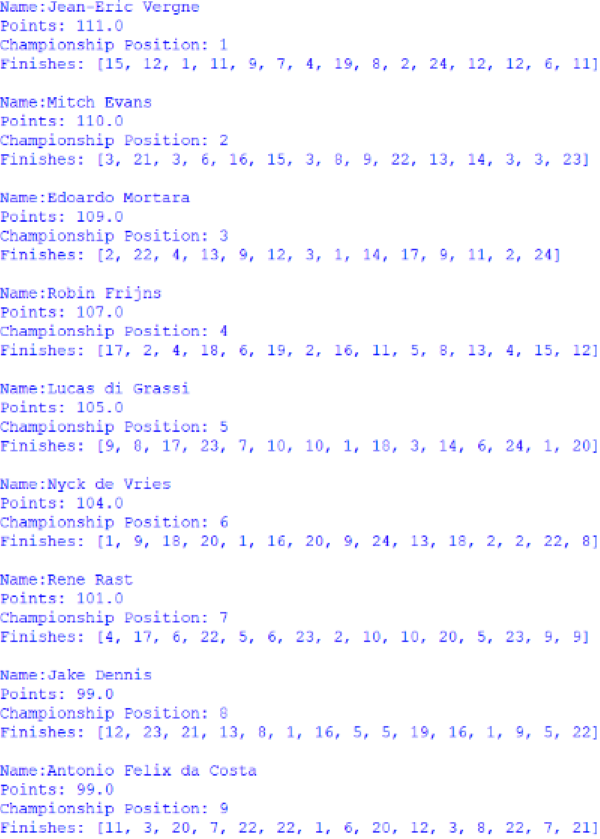
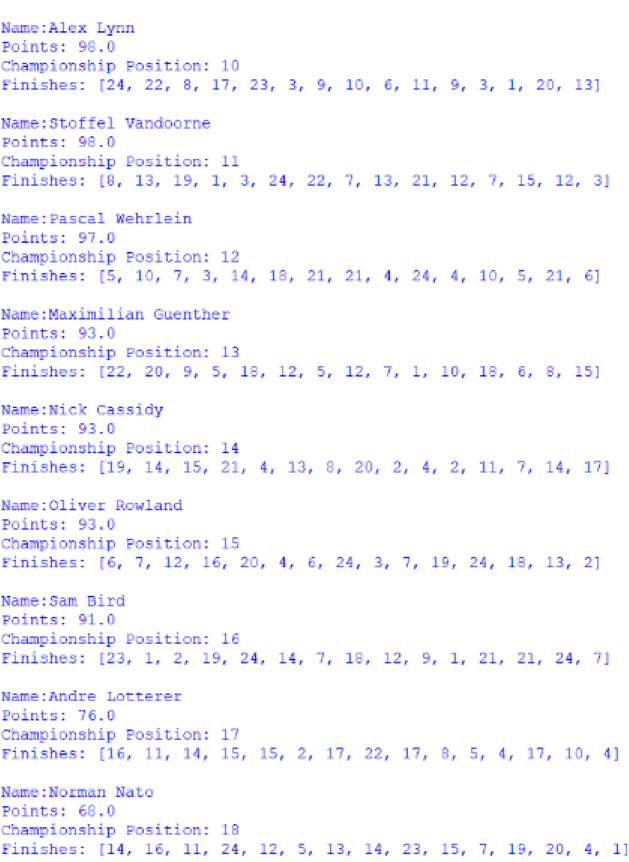
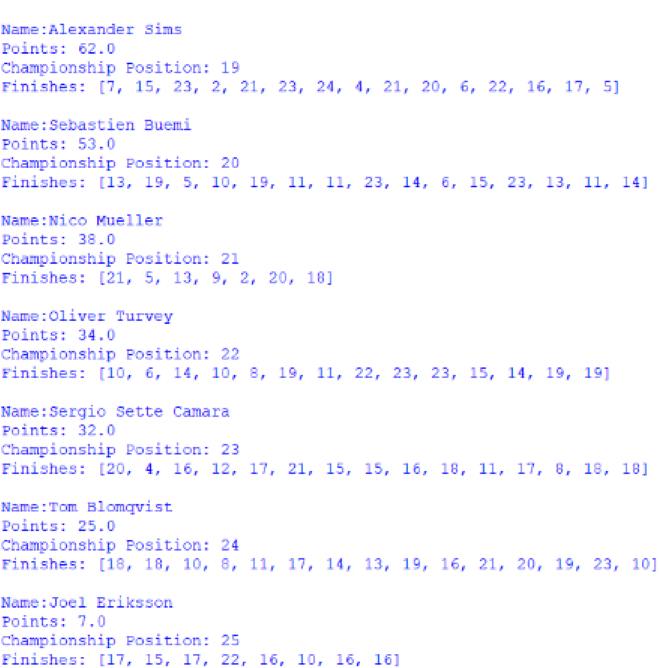
Nyck de Vries wins the championship in real life with a total of 99 points, but under the alternative format he finishes 6th with 104 points. The champion instead is Jean-Eric Vergne, who becomes a 3-time champion as well as the first Overall Drivers' Championship winner not to lead the standings going into the final race. His points total under the alternative format is 111, which compares to a points total of 80 scored in real life, which awards him 10th in the final standings in real life. 2nd place goes to Mitch Evans, who finishes with 110 points but he does not finish there in real life as he finishes in 4th with 90. 2nd place in real life goes to Edoardo Mortara who finishes with 92 points, but under the alternative format he finishes 3rd with 109 points. This loss for Mitch Evans is more heartbreaking under this format as he leads the standings going into the final race over Edoardo by 1 point and Jean-Eric, who is in 3rd, by 4. He suffers an inverter failure at the start which sees him effectively stall (this is something you can't do in an electric car due to the absence of a clutch, but an inverter is the closest equivalent) on the grid and is hit from behind by an unsighted Edoardo.
All drivers scores more points under the alternative format compared to real life and the driver who gains the most points compared to their real life total is Sebastien Buemi, who achieves 53 points which is a difference of 33, compared to his real life total of 20. This is, however, piecemeal for what was a disastrously uncompetitive season for him as he finishes 20th under alternative format compared to 21st in real life. The driver who gained the most positions compared to their final standings under the current format is the champion Jean-Eric Vergne, who gains 9 places. The driver who loses the most positions compared to where they finished under Formula E's current format is Sam Bird, who falls 10 places to finish 16th with a points score of 91 under the alternative format compared to a points total of 87 in real life. This is also the smallest gain of points anyone has over their real life points total.
Jean-Eric Vergne (I swear he isn't living rent-free in my head) only scores 2 podiums, which is less than everyone else inside except Robin Frijns and Rene Rast (they score 2 and 1 respectively), but he leads the standings in 5 races, the most of anyone and leads for the most consecutive races at 3 (New York ePrix race 1 to London ePrix 1), so he's probably a deserving champion in that respect. Also DS Techeetah has now employed the eventual champion in the last 4 seasons. There are drivers who I feel have their seasons saved by the chaotic nature of this season (e.g: Jake Dennis, Sergio Sette Camara, Nico Muller, etc) as it allows them to score better results than they should have due to inherent pace of the driver and/or car. There are a few who don't receive such breaks and they are Norman Nato and Sebastien Buemi, while Norma does win an ePrix, he still finishes 18th while his teammate finishes 3rd. Sebastien just has no pace and is constantly outclassed by Oliver, who finishes 15th with 40 more points, suggesting that the reason might be more car dependent. Also this is the first season that Lucas di Grassi doesn't finish in the top 3 of the standings (he has finished 1st or 3rd in the previous 6 seasons) and Sebastien fails to finish inside the top 4 (he has finished 2nd or 4th).
Below are the overall Drivers' Championship standings:
Customer Trophy for Drivers
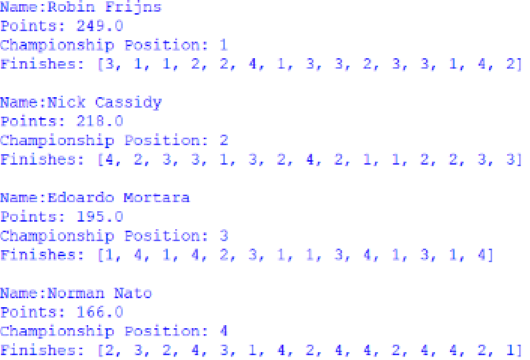
The championship is won by a resurgent Robin Frijns who beats Nick Cassidy 249 points to 218. Robin Frijns finishes every single race which, given the season, is a feat in of itself and means the most amount points can make up on him is 7, which happens only twice and Nick is only 3rd on those occasions so only pulls 2 points on Robin. This constant finishing allows Robin to seal the title 1 round early, making this the only championship not up for grabs going into the final race. A driver you would expect to be a factor is Edoardo Mortara, but he suffers 3 retirements and 1 non-start, which all add up (or rather don't) to a 3rd place finish despite winning the class 6 times. Norman Nato's dreadful season is put on display here as he has: 5 retirements and finishes last in class on a separate 3 other times, which fellow rookie driver Nick does as well, but he has 1 more win and 3 less retirements.
Below are the Customer Trophy for Drivers standings:
Nelson Piquet Jr Trophy
The winner of the Trophy is Nick Cassidy who scores 207 points over Alex Lynn, who scores on 191 points to finish 2nd. Max Guenther's record for most class wins in a season that doesn't result in the trophy, is tied by Jake Dennis, who finishes 3rd with 176 points. Nick wins the class 4 times with 3 of those wins coming consecutively. Going into the final race, Alex and Jake are tied on points and are 20 points behind, meaning they need Nick to retire and themself to win to take title, except Alex can't as he only has 2 wins, so would lose on countback. This means on lap 2 of the Berlin II ePrix (a reverse layout was used for the 2nd race, so counted as a separate race in the FIA's eyes) Nick wins the title as Jake crashes out. The record 'number of Nelson Piquet Jr Trophy class starts without a class win' briefly gets a new holder this season, as after the 1st Rome ePrix race, Nico Mueller would take it with 14 races without a win, only for him to win 2 races later in the 1st Valencia ePrix race. Thus Gary Paffett, who has 13 starts without a class win, retains is title although Norman Nato comes dangerously close, but he wins in his 14th start.
Below are the Nelson Piquet Jr Trophy standings:

Overall Teams' Championship
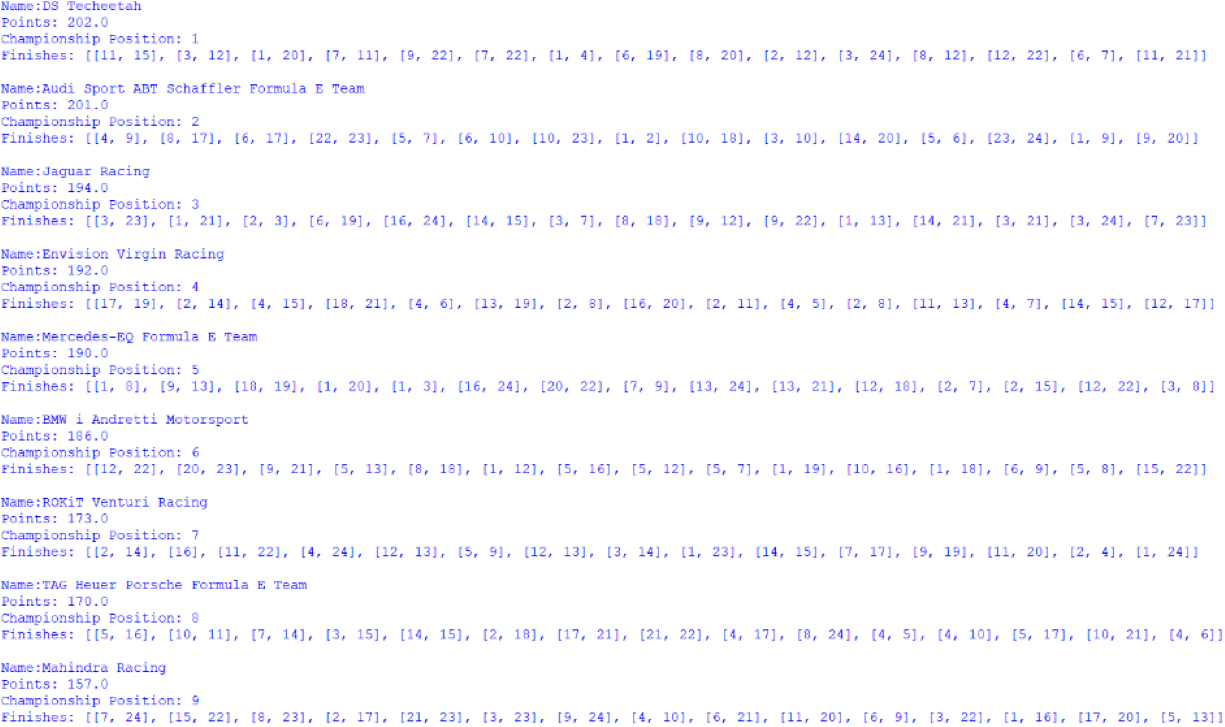
Mercedes-EQ Formula E Team win their 1st ever teams title in real life with a points total of 181, but under the alternative format they finish 5th with a points total of 190. The winners of the championship under the alternative format are the champion's employers: DS Techeetah. They score 202 points under the alternative format compared to a total of 166 points and a 3rd place finish in the championship in real life. Techeetah lead the teams standings from Monaco (round 7) onwards, with the exception of after 2nd London ePrix, where the lose it to Envision Virgin Racing but take it back after next race. Despite leading the standings for most of the season, they only finish 1 point ahead of Audi Sport ABT Schaeffler Formula E Team and while it's not for the championship, they also finish 1 point ahead of ABT in real life. With this win, Techeetah tie with e.dams for most team titles all time at 3. All teams score more points under the alternative format than they do in real life and the top 5 positions look wildly different between the 2 standings as: Techeetah and ABT move up 2 places to finish 1st and 2nd rather than 3rd and 4th respectively, Jaguar Racing drops 1 place to finish 3rd, Envision Virgin Racing moves up 1 place to finish 4th, and Mercedes craters to finish 5th instead of 1st.
Below are the overall Teams' Championship standings:

Customer Teams' Championship
This season's Customer Teams' Championship is a lot like last years in that: the winning team scored points in all races and the losing team won more races. The only differences is the teams are swapped around so Envision Virgin Racing win over ROKiT Venturi Racing and they must wait until the final round to take the title. Venturi effectively lose the championship after race 1 of the Valencia ePrix, as both cars retire from the farce that was that race, due to a lack of available power and thus are 20 points out, having being tied with Virgin going into that race. Venturi finish the season 14 points off, so if they had finished that race in Valencia, they would have won the championship by 1 point as they would have scored 15 points for 3rd place in class. This championship will get some proper competition next season, as with the withdrawal of BMW from the sport at the end of this season, Andretti will become a customer team again and we will have 3 teams rather than 2.
Below are the Customer Teams' Championship standings:

Manufacturers' Cup
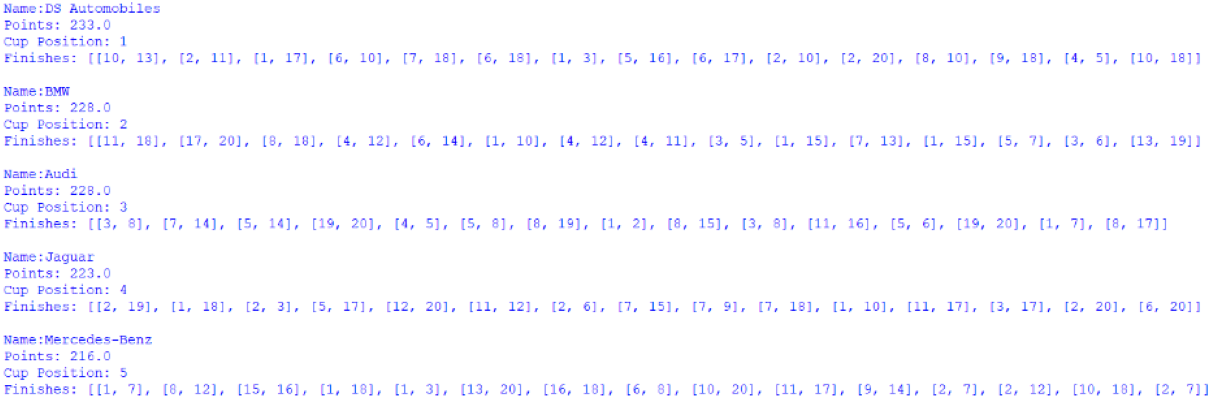
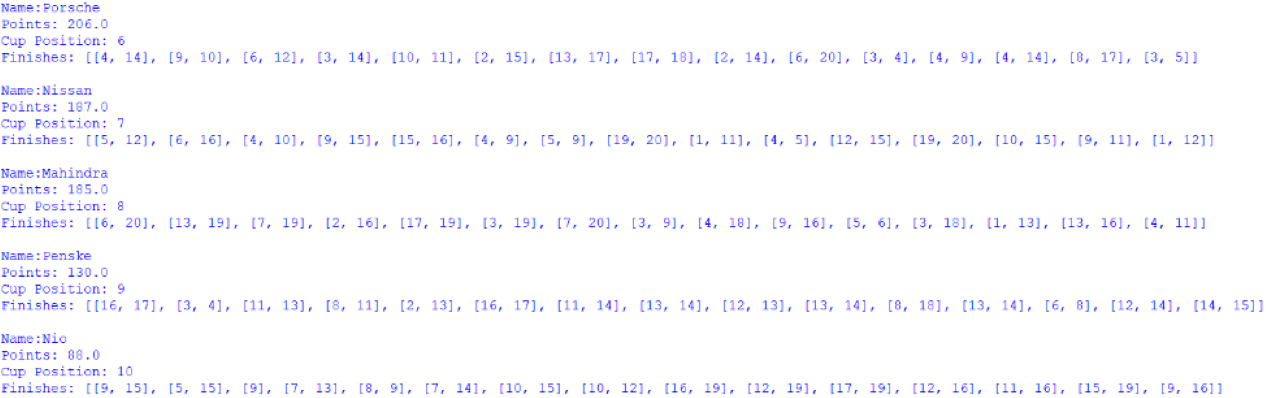
DS Automobiles win another Manufacturers' Cup with points total of 233 over BMW and Audi, both who finish with 228 points, although BMW takes 2nd on countback courtesy of 3 wins to Audi's 2. DS would have not won the Manufacturers' Cup if it had been run in Season 7, as instead they finish 4th on 166 points. The hypothetical winners of the cup in real life would have been Mercedes-Benz, who finish the season with 298 points from Audi who finishes 2nd with 289 points. Unlike the teams and drivers in real life, Mercedes are not leading this going into the final round as Audi, in their swansong season, look primed to take another cup home, but a poor performance all round (only 1 car scores manufacturer points) sees the title swing in Mercedes' favour. Audi and Mercedes are the only manufacturers to score less points in real life compared to the alternative format. Only Porsche, Penske and Nio keep the same championship position across both formats as: DS and BMW fall 3 places to finish 4th and 5th in real life respectively, Audi and Jaguar move up 1 place to finish 2nd and 3rd in real life respectively and Mahindra and Nissan swap places, so Mahindra finish ahead of Nissan in real life.
Below are the Manufacturers' Cup standings:
- Previous: If Witch Then Which? Volume 3.
- Next: After Eight